Showing posts with label environment. Show all posts

Tuesday, January 19, 2016

Rest Your Heart (Blue Cliff Monastery)


This type of artwork is the grandparent to the earliest movies, made and "cranked" by hand. Thank you to Tina Swift for making this happen and to Sarah Martin for the phenomenal song. Happy New Year, Everyone!
Lyrics:

REST YOUR HEART – by Sarah Martin

In a time with no beginning, swimming through the cosmic sea,

one day the darkness grew so lonely, she said, “My heart feels so heavy.”

And her sister, the light, was listening. She said, “My dear, come lean on me,

for we are the heartbeat of the cosmos, and together we are free.

[CHORUS:] “So come and lean on me. Rest your heart with me.

We are not one without the other. Don't be afraid to lean on me.”


There is a tree deep in the forest. She has a heart like you and me.

One day she felt the greatest sadness. She said, “My heart feels so heavy.”

And deep below her, the bedrock was listening, and she said, “Please lean down on me,

for I am resting on the cosmos, that's why my heart is so strong and free.” [CHORUS]


One night, a deer came wandering into the forest dark and deep.

She had traveled weary miles, and her heart cried out for sleep.

Then a voice came out of the silence. It said, “My dear, come lean on me,

for I am resting on the bedrock, that's why my heartwood is strong and free.” [CHORUS]


A mother came into the forest carrying her baby, fast asleep.

The night was cold and she was weary, and her heart began to weep.

And then she heard a whisper in the darkness, so gentle and so sweet.

It said, “Dear Mother, come lean against me, and we can share each other's heat.

For this old tree is strong and steady, and I'm as cozy as we can be.

We are not one without the other. Don't be afraid to lean on me.” [CHORUS]


The little baby, his eyes came open, there in the darkness, there in the wild.

He could feel the warmth around him, he could feel his mother's smile.

And he said to all the beings in the cosmos, “Well, you can come and lean on me,

for I am leaning on my mother who is resting with the deer against this tree.

And we are all leaning on the bedrock on the cosmos, a mystery.

We are all leaning on each other. Don't be afraid to lean on me.” [CHORUS (2x)]

We are not one without the other. Don't be afraid to lean on me.
ALL COMMENTS (4)

Monday, December 10, 2012

Healing Ecology

Tigress
This article from the Tricycle Wisdom series by David R. Loy addresses the collective dukka (suffering) that comes from separating our own well-being from the well-being of the whole of creation, in other words, from our dualistic perspective. In an attempt to reinforce our individual sense of self through the use of increasingly sophisticated technology, we unwittingly reinforce our own anxiety because such attempts are ultimately futile since we are not separate. Dr. Loy argues that embracing our collective natures and seeing ourselves as a part of the entire natural system is the only way to heal both ourselves and the earth.


As a complex religious tradition, or group of traditions, Buddhism has a lot to say about the natural world. Passages in many Buddhist texts reveal sensitivity to the beauties of nature and respect for its various beings. A good example is the Jataka tales (“birth stories”) that describe the previous lives of the Buddha before he became the Buddha. In many of them he is born as an animal, and in some of the best-known tales the Buddha sacrifices himself for “lower animals,” such as offering his rabbit body to a weak tigress so that she can feed her starving cubs. Such fables challenge the duality usually assumed between humans and “nature”— as if we were not part of nature! They suggest that the welfare of every living being, no matter how insignificant it may seem to us, is spiritually important and deserving of our concern. All beings in the Jatakas are able to feel compassion for others and act selflessly to help ease their suffering. In contrast to a Darwinian “survival of the fittest,” which is often used to justify our abuse of other species, its stories offer a vision of life in which we are all interconnected, parts of the same web of life, and therefore also inter-responsible, responsible for each other.
This compassion is not limited to the animal realm. If we can believe the traditional biographies, the Buddha was born under trees, meditated under trees, experienced his great awakening under trees, often taught under trees, and passed away under trees. Unsurprisingly, he often expressed his gratitude to trees and other plants. Some later Buddhist texts explicitly deny that plants have sentience, but the Pali Canon is more ambiguous. In one sutra, a tree spirit appears to the Buddha in a dream, complaining that its tree had been chopped down by a monk. The next morning the Buddha prohibited sangha members from cutting down trees. Monks and nuns are still forbidden to cut off tree limbs, pick flowers, even pluck green leaves off plants.
Yet great sensitivity to nature is hardly unique to Buddhism. So what special perspective, if any, does Buddhism offer to our understanding of the biosphere, and our relationship to it, at this critical time in history when we are doing our utmost to destroy it?
To answer that question, we have to go back to a more basic question: what is really distinctive about Buddhism? The four noble (or “ennobling”) truths are all about dukkha, and the Buddha emphasized that his only concern was ending dukkha. To end our dukkha, however, we need to understand and experience anatta, our lack of self, which seen from the other side is also our interdependence with all other things.
There are different ways to explain anatta, yet fundamentally it denies our separation from other people and from the rest of the natural world. The psychosocial construction of a separate self in here is at the same time the construction of an “other” out there, that which is different from me. What is special about the Buddhist perspective is its emphasis on the dukkha built into this situation. Basically, the self is dukkha.
One way to express the problem is that the sense of self, being a construct, is always insecure, because inherently ungrounded. It can never secure itself, because there is no-thing that could be secured. The self is more like a process, or a function. The problem with processes, however, is that they are always temporal, necessarily impermanent—but we don’t want to be impermanent, something that is changing all the time. We want to be real! So we keep trying to ground ourselves, often in ways that just make our situation worse. For Buddhism the only true solution lies in realizing our nonduality with “others” and understanding that our own well-being cannot be distinguished from their well-being.
Does this basic insight about the intimate connection between sense of self and dukkha also apply to the sense of separation between ourselves and others? The issue here is whether “separate self = dukkha” also holds true for our biggest collective sense of self: the duality between us as a species, Homo sapiens, and the rest of the biosphere.
If this particular parallel between individual and collective selves holds, there are two important implications. First, our collective sense of separation from the natural world must also be a constant source of collective frustration for us. Secondly, our responses to that alienation, by trying to make our collective species-self more real—in this case, by attempting to secure or “self-ground” ourselves technologically and economically—are actually making things worse.
Western civilization developed out of the interaction between Judeo-Christianity and the culture of classical Greece. Greek culture emphasized our uniqueness by distinguishing the conventions of human society (culture, technology, and so on) from the rhythms of the natural world. What is important about this distinction is the realization that whatever is social convention can be changed: we can reconstruct our own societies and attempt to determine our own collective destiny.
Today we take that insight for granted, yet it’s not something that most premodern, traditionally conservative societies would have understood. Without our sense of historical development, they have usually accepted their own social conventions as inevitable because also natural. This often served to justify social arrangements that we now view as unjust, but there is nevertheless a psychological benefit in thinking that way: such societies shared a collective sense of meaning that we have lost today. For them, the meaning of their lives was built into the cosmos and revealed by their religion, which they took for granted. For us, in contrast, the meaning of our lives and our societies has become something that we have to determine for ourselves in a universe whose meaningfulness (if any) is no longer obvious. Even if we choose to be religious, we today must decide between various religious possibilities, which diminishes the spiritual security that religions have traditionally provided. While we have a freedom that premodern societies did not have, we lack their kind of “social security,” which is the basic psychological comfort that comes from knowing one’s place and role in the world.
In other words, part of the rich cultural legacy that the Greeks bequeathed the West—for better and worse—is an increasing anxiety about who we are and what it means to be human. There is a basic tension between such freedom (we decide what to value and what to do) and security (being grounded in something greater, which is taking care of us), and we want both. As soon as one of them is emphasized, we want more of the other. In general, however, the modern history of the West is a story of increasing freedom at the cost of decreasing security, in the sense that loss of faith in God has left us rudderless. Thanks to ever more powerful technologies, it seems like we can accomplish almost anything we want to do—yet we don’t know what our role is. That continues to be a source of great anxiety, not only for us individually but collectively. What sort of world do we want to live in? What kind of society should we have? If we can’t depend on God to tell us, we are thrown back upon ourselves, and our lack of any grounding greater than ourselves is a profound source of suffering. This helps us to understand why our collective sense of separation from the natural world is a continual source of frustration. The stronger our alienation from nature, the greater our anxiety.
This brings us to the second implication mentioned earlier: our collective response to this collective dukkha is just making things worse. First, let’s remember how things go wrong individually. We usually respond to the delusion of a separate self by trying to make that sense of self more real—which doesn’t work and can’t work, since there is no such self that can be isolated from its relationships with others. Since we don’t realize this, we tend to get caught up in vicious circles. I never have enough money or power; I’m never famous enough, attractive enough.
When we think about our collective response from this perspective, I think the motivation becomes clear. Lacking the security that comes from knowing one’s place and role in the cosmos, we have been trying to create our own security. Technology, in particular, is our collective attempt to control the conditions of our existence on this earth. We have been trying to remold the earth so that it is completely adapted to serve our purposes, until everything becomes subject to our will, a “resource” that we can use. Ironically, though, this hasn’t been providing the sense of security and meaning that we seek. We have become more anxious, not less. That’s because technology can be a great means, but in itself it’s a poor goal.
Sooner or later, one way or another, we will bump up against the limits of this compulsive but doomed project of endless growth. Since our increasing reliance on technology as the solution to life’s problems is itself a large part of the problem, the ecological crisis does not call for a primarily technological response. Dependence on sophisticated, ever more powerful technologies tends to aggravate our sense of separation from the natural world, whereas any successful solution must involve accepting that we are part of the natural world. That, of course, also means embracing our responsibility for the well-being of the biosphere, because its well-being ultimately cannot be distinguished from our own well-being.
The solution does not lie in “returning to nature.” We cannot return to nature, because we have never left it. That way of describing the natural world is dualistic; it dichotomizes between us and where we are located. The environment is not merely the place where we live and act, for the biosphere is the ground from which and within which we arise. The earth is not only our home, it is our mother. In fact, our relationship is even more intimate, because we can never cut the umbilical cord. The air in my lungs, like the water and food that pass through my mouth, is part of a great system that does not stop with me but continually circulates through me. My life is a dissipative process that depends upon and contributes to that never-ending circulation. Eventually I too will be food for worms.
Any genuine solution to the ecological crisis must involve something more than technological improvements. If the root of the problem is spiritual, the solution must also have a spiritual dimension. And again, this does not mean a return to premodern religious conviction, which is impossible for us today. Buddhism shows another way, which de-emphasizes the role of dogma and ritual. The Buddhist approach is quite pragmatic. The goal of the Buddhist path is wisdom in service of personal and social transformation. When we meditate, for example, we are not transforming ourselves. We are being transformed. Quiet, focused concentration enables something else to work in us and through us, something other than one’s usual ego-self. This opens us up and liberates a deeper grounding within ourselves. Our lack of self is what enables this process; it frees us from the compulsion to secure ourselves within the world. We do not need to become more real by becoming wealthy, or famous, or powerful, or beautiful. We are able to realize our nonduality with the world because we are freed from such fixations.
Although living beings are numberless, the bodhisattva vows to save them all. He or she assumes the grandest possible role, on a path that can never come to an end. Although such a commitment is not compulsory, it follows naturally from realizing that none of those beings is separate from oneself. We discover the meaning we seek in the ongoing, long-term task of repairing the rupture between us and Mother Earth, our natural ground. That healing will transform us as much as the biosphere.

David R. Loy is a professor, writer, and Zen teacher in the Sanbo kyodan tradition of Japanese Zen Buddhism. His books include A Great Awakening: Buddhist Social Theory andThe World is Made of Stories. This article was adapted from Money, Sex, War, Karma: Notes for a Buddhist Revolution by David R. Loy © 2008. Reprinted with permission of Wisdom Publications, wisdompubs.org.
Image: The Starving Tigress, Buryatia, 1800-1899. Buddhist lineage, ground mineral pigment on cotton. Collection of Buryat Historical Museum.


Monday, November 26, 2012

Are We Circling The Drain?


Stand Still for the Apocalypse

Email this item EMAIL    Print this item PRINT    

Posted on Nov 26, 2012
AP/Elizabeth Dalziel

In much of the world, including China and the United States, dirty energy remains cheap and plentiful, with disastrous consequences.
Humans must immediately implement a series of radical measures to halt carbon emissions or prepare for the collapse of entire ecosystems and the displacement, suffering and death of hundreds of millions of the globe’s inhabitants, according to a report commissioned by the World Bank. The continued failure to respond aggressively to climate change, the report warns, will mean that the planet will inevitably warm by at least 4 degrees Celsius (7.2 degrees Fahrenheit) by the end of the century, ushering in an apocalypse.
The 84-page document,“Turn Down the Heat: Why a 4°C Warmer World Must Be Avoided,” was written for the World Bank by the Potsdam Institute for Climate Impact Research and Climate Analytics and published last week. The picture it paints of a world convulsed by rising temperatures is a mixture of mass chaos, systems collapse and medical suffering like that of the worst of the Black Plague, which in the 14th century killed 30 to 60 percent of Europe’s population.
A planetwide temperature rise of 4 degrees C—and the report notes that the tepidness of the emission pledges and commitments of the United Nations Framework Convention on Climate Change will make such an increase almost inevitable—will cause a precipitous drop in crop yields, along with the loss of many fish species, resulting in widespread hunger and starvation. Hundreds of millions of people will be forced to abandon their homes in coastal areas and on islands that will be submerged as the sea rises. There will be an explosion in diseases such as malaria, cholera and dengue fever. Devastating heat waves and droughts, as well as floods, especially in the tropics, will render parts of the Earth uninhabitable. The rain forest covering the Amazon basin will disappear. Coral reefs will vanish. Numerous animal and plant species, many of which are vital to sustaining human populations, will become extinct. Monstrous storms will eradicate biodiversity, along with whole cities and communities. And as these extreme events begin to occur simultaneously in different regions of the world, the report finds, there will be “unprecedented stresses on human systems.” Global agricultural production will eventually not be able to compensate. Health and emergency systems, as well as institutions designed to maintain social cohesion and law and order, will crumble. The world’s poor, at first, will suffer the most. But we all will succumb in the end to the folly and hubris of the Industrial Age. And yet, we do nothing.
“It is useful to recall that a global mean temperature increase of 4°C approaches the difference between temperatures today and those of the last ice age, when much of central Europe and the northern United States were covered with kilometers of ice and global mean temperatures were about 4.5°C to 7°C lower,” the report reads. “And this magnitude of climate change—human induced—is occurring over a century, not millennia.”
The political and corporate elites in the industrialized world continue, in spite of overwhelming scientific data, to place short-term corporate profit and expediency before the protection of human life and the ecosystem. The fossil fuel industry is permitted to determine our relationship to the natural world, dooming future generations. Carbon dioxide (CO2), the main greenhouse gas, increased from its pre-industrial concentration of about 278 parts per million (ppm) to more than 391 ppm in September 2012, with the rate of rise now at 1.8 ppm per year. We have already passed the tipping point of 350 ppm; above that level, life as we have known it cannot be sustained. The CO2 concentration is higher now than at any time in the last 15 million years. The emissions of CO2, currently about 35 billion metric tons per year, are projected to climb to 41 billion metric tons per year by 2020. 
Advertisement
Because about 90 percent of the excess heat trapped by the greenhouse effect since 1955 is momentarily in the oceans, we have begun a process that, even if we halted all carbon emissions today, will ensure rising sea levels and major climate disruptions, including the continued melting of the Greenland and Antarctic ice sheets as well as the acidification of the oceans. The report estimates that if warming accelerates toward 4 degrees Celsius, sea levels will rise 0.5 to 1 meter, possibly more, by 2100. Sea levels will increase several meters more in the coming centuries. If warming can be keep to 2 degrees or below, sea levels will still rise, by about 20 centimeters by 2100, and probably will continue to rise between 1.5 and 4 meters above present-day levels by the year 2300. Sea-level rise, the report concludes, is likely to be below 2 meters only if warming is kept to well below 1.5 degrees. The rise in sea levels will not be uniform. Coastal areas in tropical regions will be inundated by sea-level rises that are up to 20 percent higher than those in higher latitudes.
“In particular, the melting of the ice sheets will reduce the gravitational pull on the ocean toward the ice sheets and, as a consequence, ocean water will tend to gravitate toward the Equator,” the report reads. “Changes in wind and ocean currents due to global warming and other factors will also affect regional sea-level rise, as will patterns of ocean heat uptake and warming. Sea-level rise impacts are projected to be asymmetrical even within regions and countries. Of the impacts projected for 31 developing countries, only 10 cities account for two-thirds of the total exposure to extreme floods. Highly vulnerable cities are to be found in Mozambique, Madagascar, Mexico, Venezuela, India, Bangladesh, Indonesia, the Philippines, and Vietnam. For small island states and river delta regions, rising sea levels are likely to have far ranging adverse consequences, especially when combined with the projected increased intensity of tropical cyclones in many tropical regions, other extreme weather events, and climate change-induced effects on oceanic ecosystems (for example, loss of protective reefs due to temperature increases and ocean acidification).”
“By the time the concentration reaches around 550 ppm (corresponding to a warming of about 2.4°C in the 2060s), it is likely that coral reefs in many areas would start to dissolve,” the report reads. “The combination of thermally induced bleaching events, ocean acidification, and sea-level rise threatens large fractions of coral reefs even at 1.5°C global warming. The regional extinction of entire coral reef eco-systems, which could occur well before 4°C is reached, would have profound consequences for their dependent species and for the people who depend on them for food, income, tourism, and shoreline protection.” The report projects that the rates of change in ocean acidity over the next century will be “unparalleled in Earth’s history.”
The global production of maize and wheat has, because of rising temperatures, been in steady decline since the 1980s. But these crop declines will be vastly accelerated in the coming years, with rising temperatures resulting in widespread malnutrition and starvation. It will mean that the poor, and especially children, will endure chronic hunger and malnutrition. There will be an increase in a variety of deadly epidemic diseases. Persistent flooding will contaminate drinking water, spreading diarrheal and respiratory illnesses. The 2012 drought, which affected 80 percent of the agricultural land in the United States, will become the norm. Tropical South America, Central Africa and all tropical islands in the Pacific are, the report says, likely to regularly experience heat waves of unprecedented magnitude, making human life in these areas difficult if not impossible to sustain.
“In this new high-temperature climate regime, the coolest months are likely to be substantially warmer than the warmest months at the end of the 20th century,” the report reads. “In regions such as the Mediterranean, North Africa, the Middle East, and the Tibetan plateau, almost all summer months are likely to be warmer than the most extreme heat waves presently experienced. For example, the warmest July in the Mediterranean region could be 9°C warmer than today’s warmest July.” It notes that these changes “potentially exceed the adaptive capacities of many societies and natural systems.”
The stress and insecurity caused by the breakdown in the climate will, the report says, “have negative effects on psychological and mental health.” It will lead to an increase in “levels of conflict and violence.” These changes “will have ramifications for national identification and alter the dynamics of traditional cultures.”

Advertisement
The report calls on the leaders of the industrial world to immediately institute radical steps—including a halt to the dependence on fossil fuels—to keep the global temperature rise below 2 degrees C, although the report concedes that even an increase of less than 2 degrees would result in serious damage to the environment and human populations. Without a massive investment in green infrastructure that can adapt to the heat and other new extreme weather, and in the building of efficient public transportation networks and renewable energy systems to minimize carbon emissions, we will succumb to our own stupidity. 
A failure to respond will assure an ecological nightmare that will most probably be accompanied by an economic, social and political breakdown. The human species, the report says, will cross “critical social system thresholds,” and “existing institutions that would have supported adaptation actions would likely become much less effective or even collapse.” The “stresses on human health, such as heat waves, malnutrition, and decreasing quality of drinking water due to seawater intrusion, have the potential to overburden health-care systems to a point where adaptation is no longer possible, and dislocation is forced.”
“There is also no certainty that adaptation to a 4°C world is possible,” it goes on. “A 4°C world is likely to be one in which communities, cities and countries would experience severe disruptions, damage, and dislocation, with many of these risks spread unequally. It is likely that the poor will suffer most and the global community could become more fractured, and unequal than today. The projected 4°C warming simply must not be allowed to occur—the heat must be turned down.”

Friday, August 10, 2012

Devastation in the Mid West


It is certainly getting harder to deny that the planet is heating up beyond what modern society can bear. Along with the increase in temperatures comes a whole panoply of problems from the decrease of bee populations and the resulting decrease in crop pollination, to the diminishing aquifers, a water source that has existed since the beginning of time and which is seriously threatened by pollution and over use. Many of the areas affected by serious drought lie in very conservative parts of the nation. My hope is that when this segment of the population begins to see the reality of global warming they will push for legislation that will support a saner environmental  policy. Not to do so will mean sustained suffering for all and will push modern society to the brink.

Click here for a few photographs and the heartbreaking story of one farmer.

Thursday, May 10, 2012

Earth911

You can find the location to recycle a number of household items, especially toxic items like cfl lightbulbs by going to www.earth911.com and typing in your zip code. Very easy and lots of good tips for living more sanely and environmentally.

Monday, April 30, 2012

The Cult of the Self and it's Implications.

Welcome to the Asylum


A well articulated analysis of society's current state of decline and it's causes. The pressing question is "Can we turn this around?" Is there any possibility to interrupt this cycle and pull out of the suicide dive we find ourselves in?

Welcome To The Asylum by Chris Hedges
When civilizations start to die they go insane. Let the ice sheets in the Arctic melt. Let the temperatures rise. Let the air, soil and water be poisoned. Let the forests die. Let the seas be emptied of life. Let one useless war after another be waged. Let the masses be thrust into extreme poverty and left without jobs while the elites, drunk on hedonism, accumulate vast fortunes through exploitation, speculation, fraud and theft. Reality, at the end, gets unplugged. We live in an age when news consists of Snooki’s pregnancy, Hulk Hogan’s sex tape and Kim Kardashian’s denial that she is the naked woman cooking eggs in a photo circulating on the Internet. Politicians, including presidents, appear on late night comedy shows to do gags and they campaign on issues such as creating a moon colony. “[A]t times when the page is turning,” Louis-Ferdinand Celine wrote in “Castle to Castle,” “when History brings all the nuts together, opens its Epic Dance Halls! hats and heads in the whirlwind! Panties overboard!”
The quest by a bankrupt elite in the final days of empire to accumulate greater and greater wealth, as Karl Marx observed, is modern society’s version of primitive fetishism. This quest, as there is less and less to exploit, leads to mounting repression, increased human suffering, a collapse of infrastructure and, finally, collective death. It is the self-deluded, those on Wall Street or among the political elite, those who entertain and inform us, those who lack the capacity to question the lusts that will ensure our self-annihilation, who are held up as exemplars of intelligence, success and progress. The World Health Organization calculates that one in four people in the United States suffers from chronic anxiety, a mood disorder or depression—which seems to me to be a normal reaction to our march toward collective suicide. Welcome to the asylum.
When the most basic elements that sustain life are reduced to a cash product, life has no intrinsic value. The extinguishing of “primitive” societies, those that were defined by animism and mysticism, those that celebrated ambiguity and mystery, those that respected the centrality of the human imagination, removed the only ideological counterweight to a self-devouring capitalist ideology. Those who held on to pre-modern beliefs, such as Native Americans, who structured themselves around a communal life and self-sacrifice rather than hoarding and wage exploitation, could not be accommodated within the ethic of capitalist exploitation, the cult of the self and the lust for imperial expansion. The prosaic was pitted against the allegorical. And as we race toward the collapse of the planet’s ecosystem we must restore this older vision of life if we are to survive.
The war on the Native Americans, like the wars waged by colonialists around the globe, was waged to eradicate not only a people but a competing ethic. The older form of human community was antithetical and hostile to capitalism, the primacy of the technological state and the demands of empire. This struggle between belief systems was not lost on Marx. “The Ethnological Notebooks of Karl Marx” is a series of observations derived from Marx’s reading of works by historians and anthropologists. He took notes about the traditions, practices, social structure, economic systems and beliefs of numerous indigenous cultures targeted for destruction. Marx noted arcane details about the formation of Native American society, but also that “lands [were] owned by the tribes in common, while tenement-houses [were] owned jointly by their occupants.” He wrote of the Aztecs, “Commune tenure of lands; Life in large households composed of a number of related families.” He went on, “… reasons for believing they practiced communism in living in the household.” Native Americans, especially the Iroquois, provided the governing model for the union of the American colonies, and also proved vital to Marx and Engel’s vision of communism.

To read the entire article (one more page) follow this link:
http://www.truthdig.com/report/item/welcome_to_the_asylum_20120430//


Monday, September 19, 2011

The Human Planet

A beautiful collection of video footage on the majesty and struggle for survival of humans on this planet. Very inspiring from the BBC collection.

\http://www.youtube.com/watch?v=2HiUMlOz4UQ&feature=player_popout

Saturday, July 16, 2011

No To Arctic Drilling

An amazing five minutes to show you why we must keep the arctic free from corporate interests

http://www.youtube.com/embed/SkY03n0_sD8

Thursday, June 23, 2011

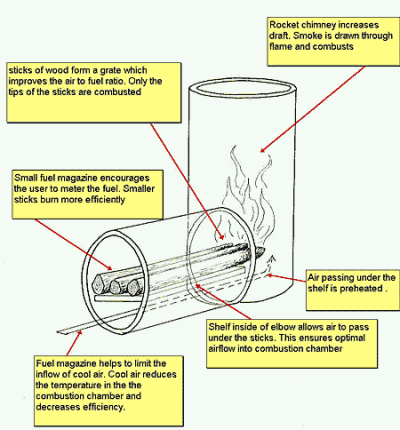
Tin Can Rocket Stove

eWatch the video for a simple explanation of how to build this stove, which is highly efficient, and uses very little solid fuel (small twigs) to produce smokeless heat.

http://solarcooking.wikia.com/wiki/Rocket_Stove


Thursday, May 26, 2011

Living Large in a Small Way

Check out the 64square foot house that Dee Williams lives in! Gives a new definition to downsizing. Whatever form that might take, it is the new reality for a sustainable future; finding ways to use less without necessarily losing on the quality of life one experiences.

Follow the link:
http://www.youtube.com/watch?v=eZM2G-PfEbc&feature=player_embedded

Monday, December 20, 2010

Trust Yourself and Believe

Inspiring TED talk about perseverance and spirit. William Kamkwamba overcame many obstacles in his fight to better himself and his family. This short TED talk will amaze you with his indomitable spirit.

At age 14, in poverty and famine, this Malawian boy built a windmill to power his family's home. Now at 22, William Kamkwamba, who speaks at TED, here, for the second time, shares in his own words the moving tale of invention that changed his life.

Follow the link:
http://www.ted.com/talks/william_kamkwamba_how_i_harnessed_the_wind.html

Thursday, December 16, 2010

Rising Water Parable

The waters were rising in the story of the man

on the roof of his house waiting for God to save him.

A boatman pulled up asking if he could help.

A helicopter hovered overhead and asked if he needed help.

Each time, the man replied, no I’m waiting for God to save me.

At the gates of heaven he asked God why he didn’t save him.

God replied, who do you think sent you a boatman and a helicopter?

Wednesday, February 10, 2010

The Story of Cap and Trade

Follow the link to find out the truth about cap and trade and the unintended consequences inherent in this type of "solution" to the CO2 rise. Annie Leonard's informing and engaging animated explanation is a great way to start understanding the issue for any age. Many links provided for further study and action.

In particular, I recommend The New York Times article Cap and Fade by James Hanson which proposes a more sensible plan called Fee and Dividend which actually rewards people for going greener.

http://www.storyofstuff.com/capandtrade/

Tuesday, February 2, 2010

E.F. Schumacher and The Religion of Economics

E F 'Fritz' Schumacher, author of 'Small Is Beautiful' talks about his philosophy in the midst of an Australian eucalyptus forest Made by M B Oldfield & Sons, 1978. Shortly after this film was made, Schumacher died in Switzerland on September 4, 1977.

In this film, Schumacher talks about how the religion of economics (making profit the only raison d'etre) ends up destroying everything that humanity really cares for; beauty, sympathy, harmony, nature, balance. With the backdrop a forestry operation in Western Australia, one sees how this idealogy has led to a battle with nature which ultimately puts us on the losing side. We have become even more of a rapacious society in the intervening years (this film was made 32 years ago!) and it has become painfully clear that  "we have become far to clever to survive without wisdom" given the power of technology and the potential (even likely) abuses of that power if placed into the hands of people who have not developed the requisite wisdom to use it. Schumacher argues that a society that uses precious non-renewable resources (oil, soil, the forest) without regard to conservation does so at its own peril. We must never lose sight of the fact that we intend to be permanent inhabitants of the planet and act as a conserver society.  We must insure that ...the asset never be destroyed and that its use is adequate to its value. Using 400 year old trees from a virgin forest for pulp wood to make paper which often eventually ends up on the side of the road as litter is not morally conscionable.

Watching this film gives good insight into Schumacher's thinking and is as timely now as ever, even more so given the state of the environment today.

Follow the link for the 43 minute film

http://video.google.com/videoplay?docid=8588539436919289072#

Monday, February 1, 2010

What it takes to flip on the light

It takes 1 pound of coal to run your bed side light for 2 nights. It takes another pound to run the tv for 4.5 hours. The average household in America uses 9.5 tons of coal per year. According to the EPA (using a study by Abt Associates which was used in the Bush administration) there are 23,600 premature deaths contributed to coal pollution. There are 38,200 non-fatal heart attacks. There are 554,000 asthma attacks. 52% of all energy in America is produced by coal.

 Follow the link for a short Frontline video about the coal conveyor belt that we hardly even see that furnishes the coal to the big production plants in the east. It will make you turn out those lights when you leave the room.

Friday, January 29, 2010

Whale Songs and Elephant Loves

Katy Payne has spent a lifetime studying the planet's largest mammals and has discovered some amazing things about the way they communicate. She has also discovered surprising ways that humans are similar to these creatures. She makes a passionate plea and argument about protecting the amazing diversity of life here on the planet. It is unimaginable that we are playing fast and easy with life on the planet. One in Four species of mammal are under threat of extinction according to her. Humans must relearn how they are part of the web of life and realize that there are consequences for our destructive behavior that are most likely deadly to us in the final analysis.
Follow the link for an interview with Katy Payne on Speaking of Faith. There are many interesting links to all the elements of the program, including very touching and rare footage of elephants in mourning.

http://speakingoffaith.publicradio.org/programs/2010/whale-songs/

Monday, January 25, 2010

N. Scott Momaday (Kiowa Elder) on the sacred


Here the Pulitzer prize winner N. Scott. Momaday speaks about the importance of the sacred, especially the concept of place as sacred, a fundamental tenant of native American indigenous philosophy. Echoing the words of Marcia Elliad (Romanian writer) he says...The sacred in all times is the revelation of the real; an encounter with that which saves us by giving meaning to our existence. In otherwords, in order for our existence to have meaning we must reconnect with and protect that which is sacred. This is a hard concept to understand in a society that relegates sacredness to the church and essentially removes God from the natural world by making him solely the creator and not the inhabitor of all creation. If we hold to that idea, we would have to treat the planet in a sacred (or at least respectful) way, something akin to the way some (if not all) native americans did before having their culture largely obliterated through contact with the european; every particle of the natural world embued with the sacred. Follow the link for an audio file of this talk